 Science To Fit
The science › Nutrition › Sports nutrition
Hydration, sodium and race day
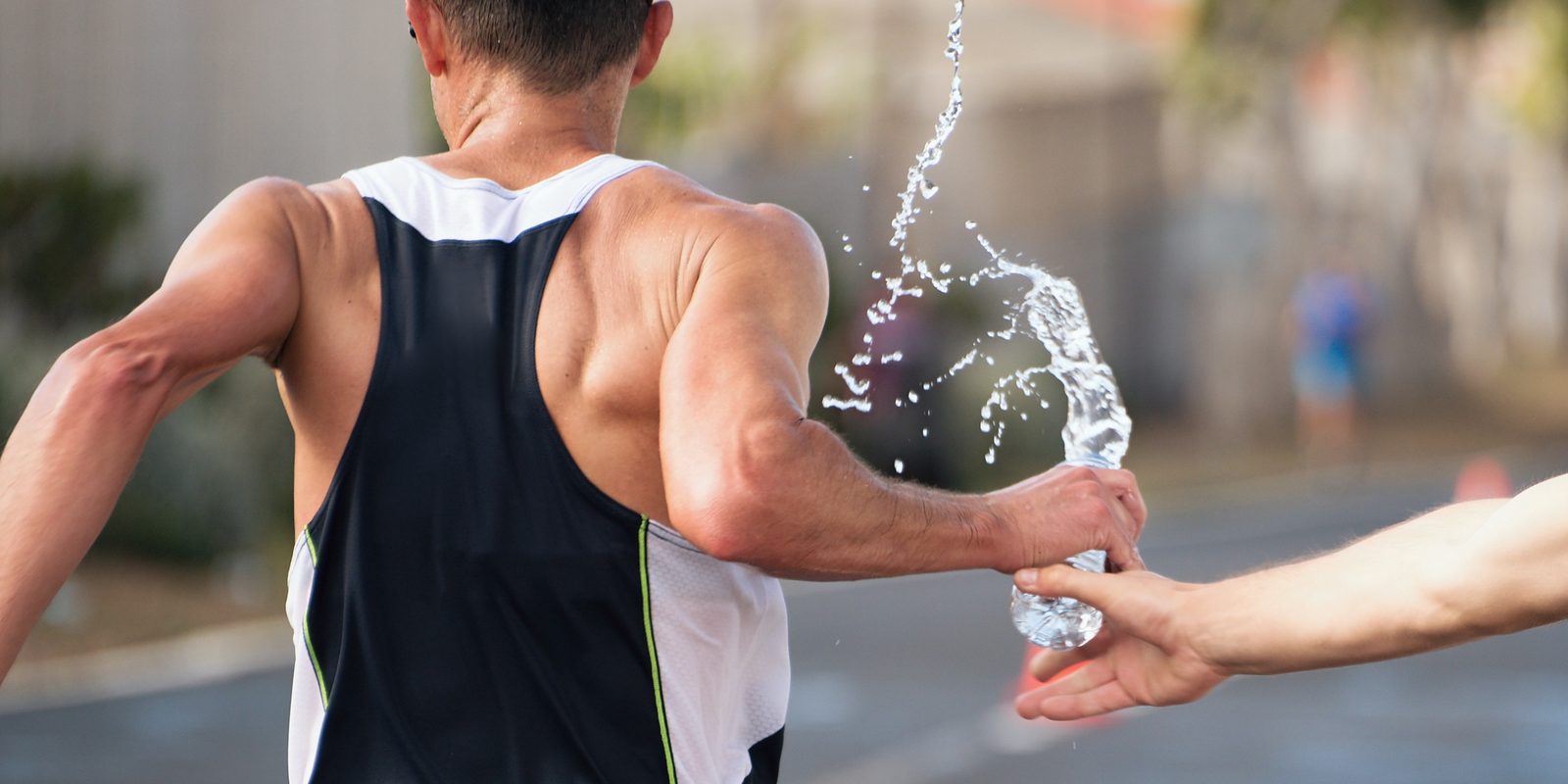
During endurance events, drink when you're thirsty instead of forcing fluids on a schedule.
Why it matters: For years runners were told to drink "ahead of thirst." Yet overdrinking is the main cause of exercise-associated hyponatremia and of all known deaths from it [1].
The big picture: Drinking far more than you sweat can cause hyponatremia, a dangerous drop in blood sodium. Mild dehydration is much less of a problem in real races than many people think. For long, hot events and heavy sweaters, a drinking plan built from your sweat rate makes sense, as long as it never has you drinking more than you lose.
What to do with this
- Drink to thirst during long events [1].
- Don't gain weight during a race. If you weigh more after a long run than before, you drank too much [1].
- Know your sweat rate for long, hot events: weigh yourself before and after a training run.
- Over about 90 minutes in the heat, or if you sweat heavily: plan your drinking from your sweat rate so you replace part of it, not more than all of it [4].
- Sports drinks and salt tablets don't protect you if you drink far too much [1, 5].
- Get help fast for confusion, severe headache, nausea or vomiting during or after a long event.
Go deeper
The terms:
- Dehydration: losing more body water than you take in. Often measured as the percentage of body weight lost during exercise.
- Hyponatremia: a low level of sodium in the blood. In exercise, it's called exercise-associated hyponatremia.
- Electrolytes: minerals such as sodium and potassium that help control fluid balance.
- Sweat rate: how much fluid you lose per hour, which varies widely between people and conditions.
What people believe: You should drink as much as you can, and by the time you're thirsty you're already too dehydrated to perform. The research doesn't support either. Many athletes also take salt to prevent cramps; no study has shown it does [5].
Overdrinking and hyponatremia:
- In the 2002 Boston Marathon, researchers tested blood from 488 runners at the finish. About 13% had hyponatremia, and 0.6% had a critically low level [2].
- The strongest risk factor was weight gain during the race, a sign of drinking more than you lose. Finishing in over 4 hours and having a body mass index at either extreme also raised risk [2].
- The type of fluid didn't matter: runners who drank sports drinks were not protected [2].
- An international expert consensus concluded that overdrinking relative to sweat losses is the main cause of exercise-associated hyponatremia and of all known deaths from it. It recommends drinking when thirsty [1].
Dehydration and performance:
- The common "2% rule" says losing 2% of body weight to sweat hurts performance.
- A meta-analysis found that in realistic time-trial tests, where athletes set their own pace and could drink to thirst, losing up to about 4% of body weight didn't reduce performance. The 2% effect showed up mainly in fixed-pace lab tests [3].
- The authors encouraged athletes to drink according to thirst [3].
The other side: planned drinking:
- Some researchers argue thirst alone isn't enough in every case. A 2018 review recommended planned drinking for events longer than about 90 minutes, especially in the heat, for athletes with high sweat rates, and when performance matters most [4].
- Its target: measure your sweat rate in race-like conditions and drink enough to keep losses under about 2% of body weight, without ever gaining weight [4].
- The review appeared in a journal supplement sponsored by the Gatorade Sports Science Institute, part of a sports-drink maker.
- Both camps agree on the danger: never drink so much that you gain weight.
Sodium:
- Sweat holds about 1 gram of sodium per liter on average, but this varies several-fold between people, and sweat rates range from about 10 oz (0.3 L) to about 2½ quarts (2.4 L) an hour [5].
- A 2022 review found that sodium taken during long events can soften a fall in blood sodium but can't prevent hyponatremia. How much fluid you drink, not how much sodium you take, decides your blood sodium at the finish [5].
- It found no documented evidence that sodium prevents exercise-associated muscle cramps [5].
- Sports nutrition guidance suggests about 300 to 600 mg of sodium an hour during prolonged exercise, mainly for long and ultra events and salty sweaters [5].
Between the lines: Slower runners have more time to overdrink. In Boston, finishing in over 4 hours raised the odds of hyponatremia about sevenfold compared with finishing in under 3½ hours [2].
Reality check: The Boston study tested only volunteers at one race. The performance meta-analysis was small, with 122 participants, mostly men in moderate conditions. The planned-drinking review is an expert review, not a trial, and few studies have tested sodium in long events directly.
How sure are we: Strong that overdrinking causes exercise-associated hyponatremia. Moderate that drinking to thirst is enough for most people in races of marathon length or less in mild weather. Early on when planned drinking beats thirst in long, hot events, and on individual sodium needs. Not supported: salt preventing cramps.
Your race-day fluid plan
- Weigh yourself nude before and after a long training run in similar weather. Each pound lost is about 16 oz of sweat not replaced.
- Aim to finish long runs a little lighter, not heavier.
- During the race, drink when thirsty at aid stations; you don't need to stop at every one.
- For events over about 90 minutes in the heat, or if you sweat heavily, use your sweat rate to plan how much to drink each hour. Replace part of what you lose, not all of it, and never more.
- For very long or hot events, a sports drink or salty snacks can help replace some sodium, but they don't make overdrinking safe.
- After the race, drink and eat normally. Don't force large amounts of water.
Sources
- Hew-Butler T, Rosner MH, Fowkes-Godek S, et al. Statement of the 3rd International Exercise-Associated Hyponatremia Consensus Development Conference, Carlsbad, California, 2015. British Journal of Sports Medicine. 2015;49(22):1432–1446. doi:10.1136/bjsports-2015-095004
- Almond CSD, Shin AY, Fortescue EB, et al. Hyponatremia among runners in the Boston Marathon. New England Journal of Medicine. 2005;352(15):1550–1556. doi:10.1056/NEJMoa043901
- Goulet EDB. Effect of exercise-induced dehydration on endurance performance: evaluating the impact of exercise protocols on outcomes using a meta-analytic procedure. British Journal of Sports Medicine. 2013;47(11):679–686. doi:10.1136/bjsports-2012-090958
- Kenefick RW. Drinking strategies: planned drinking versus drinking to thirst. Sports Medicine. 2018;48(Suppl 1):31–37. doi:10.1007/s40279-017-0844-6
- Veniamakis E, Kaplanis G, Voulgaris P, Nikolaidis PT. Effects of sodium intake on health and performance in endurance and ultra-endurance sports. International Journal of Environmental Research and Public Health. 2022;19(6):3651. doi:10.3390/ijerph19063651