 Science To Fit
The science › Exercise › Cardio and endurance
Group fitness classes
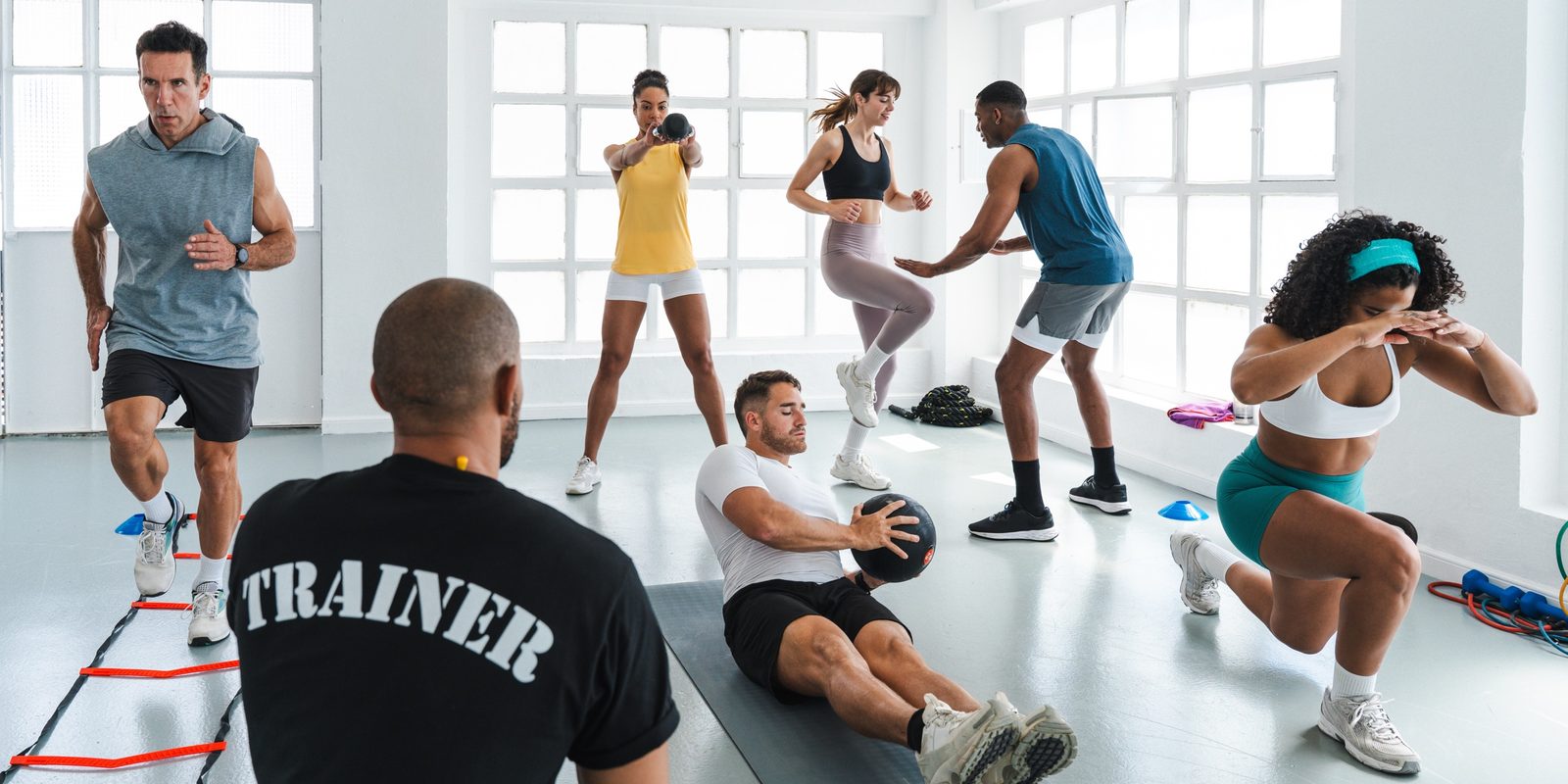
Most group classes are cardio with music, an instructor and company. They count toward your weekly cardio, but few build much strength, so pair them with lifting.
Why it matters: Classes are one of the most popular ways to exercise, and for many people the easiest way to keep showing up. Knowing what a class trains lets you fit it into any program instead of choosing between them.
The big picture: Classes that use group-building on purpose, with an instructor who learns names and builds a team feel, did better than ordinary classes in research. Pick classes you enjoy and can make every week.
What to do with this
- Count classes toward your cardio minutes. Steady classes count as moderate activity; hard intervals count as vigorous. See "The cardio dose".
- Keep at least two strength sessions a week. Most classes don't load your muscles heavily enough to replace lifting.
- Choose classes you enjoy with an instructor who knows your name. That's what keeps people coming back.
- Use "Choosing a class" to pick a class and get through your first one.
Go deeper
The terms:
- Group fitness class: an instructor-led session such as indoor cycling, dance, boot camp, step, strength ("body pump"), yoga or Pilates.
- HIIT (high-intensity interval training): short bouts of hard effort separated by easy recovery, such as 1 minute hard and 1 minute easy, repeated.
- "True group": a class where the leader deliberately builds the group, with shared goals, introductions and a sense of belonging, rather than just leading a workout for people who happen to be in the same room.
What classes do for fitness:
- Dance: a 2016 review of 11 studies with 586 adults aged 18 to 65 found Zumba improved aerobic capacity, with small effects on weight and body measurements and limited benefits for strength and flexibility. Only 4 of the 11 studies were rated high quality [2].
- Indoor cycling: a 2019 review of 13 studies with 372 people found aerobic capacity improved in every study that measured it. Most studies had no comparison group, and the authors rated the evidence very low quality [3].
- HIIT classes: intervals took off as much body fat as steady cardio in about 40% less time in a 2017 meta-analysis of 13 trials [1]. Choose them to save time, not because they burn more fat. See "Designing intervals".
Does the group help?
- A 2006 meta-analysis of 44 studies compared exercising alone at home, at home with some contact, in a standard class and in a "true group" [4].
- Exercising at home with no contact did worst. Standard classes did about as well as home programs with contact. True groups did best for sticking with it, social connection, quality of life and fitness.
- A 2026 meta-analysis of 71 studies found group and individual programs raised activity by similar amounts. Groups did slightly better for strength and flexibility, a result that depended on removing outlying studies. True groups showed larger health benefits than standard classes [5].
Classes and lifting together: A 2022 meta-analysis of 43 studies found adding cardio to lifting didn't reduce muscle growth or maximum strength. Explosive strength suffered when hard cardio and power work were done in the same session [6].
Safety: All-out intervals are very demanding. If you have heart disease or symptoms such as chest pain, talk with your doctor first. See "Exercise with a health condition".
Between the lines: The group itself is part of what makes a class work. A class you look forward to, with people who expect to see you, beats a better-designed workout you skip.
Reality check: The class studies were small and mixed in quality, and classes vary widely, even under the same name. Most group research measured how much people exercised, often by self-report, rather than fitness directly.
How sure are we: Moderate that dance and cycling classes improve aerobic fitness. Moderate that HIIT matches steady cardio for fat loss in less time. Moderate that group and individual exercise raise activity about equally, and early that deliberately built groups do better.
Fit classes into your program
| Program | How classes fit |
|---|---|
| General fitness | Count classes toward your 150 cardio minutes. Keep your two machine strength days. |
| Strength | Take classes on non-lifting days. Keep hard classes away from the day before heavy lower-body work. |
| Hypertrophy | Same as strength. A "body pump" class doesn't replace your hard sets close to failure. |
| Power | Keep hard classes at least three hours away from jumps and Olympic pulls, ideally on another day. |
| Muscular endurance | Strength and circuit classes fit this goal. One can stand in for a circuit session if it works every main muscle group. |
| Aerobic fitness | Steady classes count as easy sessions; a cycling or HIIT class can be your one hard session of the week. |
| Body composition | Classes count toward your 120 to 240 cardio minutes, such as the weekend "walk, hike or class." |
- Start with beginner classes and stand near the back until you know the moves.
- Scale the intensity to your level. You don't have to match the instructor.
- Limit very hard sessions, classes included, to two or three a week, and keep the rest of your cardio easier.
Sources
- Wewege M, van den Berg R, Ward RE, Keech A. The effects of high-intensity interval training versus moderate-intensity continuous training on body composition in overweight and obese adults: a systematic review and meta-analysis. Obesity Reviews. 2017;18(6):635–646. doi:10.1111/obr.12532
- Vendramin B, Bergamin M, Gobbo S, et al. Health benefits of Zumba fitness training: a systematic review. PM&R. 2016. doi:10.1016/j.pmrj.2016.06.010
- Chavarrias M, Carlos-Vivas J, Collado-Mateo D, Pérez-Gómez J. Health benefits of indoor cycling: a systematic review. Medicina (Kaunas). 2019;55(8):452. doi:10.3390/medicina55080452
- Burke SM, Carron AV, Eys MA, Ntoumanis N, Estabrooks PA. Group versus individual approach? A meta-analysis of the effectiveness of interventions to promote physical activity. Sport and Exercise Psychology Review. 2006;2(1):19–35.
- Kritz M, Riddell H, Olsen D, Harden SM, Burke SM, Ntoumanis N, Thøgersen-Ntoumani C. Individual versus group-based interventions: a systematic review and meta-analysis of physical activity, functional, psychosocial and health outcomes. Nature Human Behaviour. 2026. doi:10.1038/s41562-026-02429-0
- Schumann M, Feuerbacher JF, Sünkeler M, et al. Compatibility of concurrent aerobic and strength training for skeletal muscle size and function: an updated systematic review and meta-analysis. Sports Medicine. 2022;52(3):601–612. doi:10.1007/s40279-021-01587-7