 Science To Fit
The science › Exercise › Programs and planning
Test your own fitness
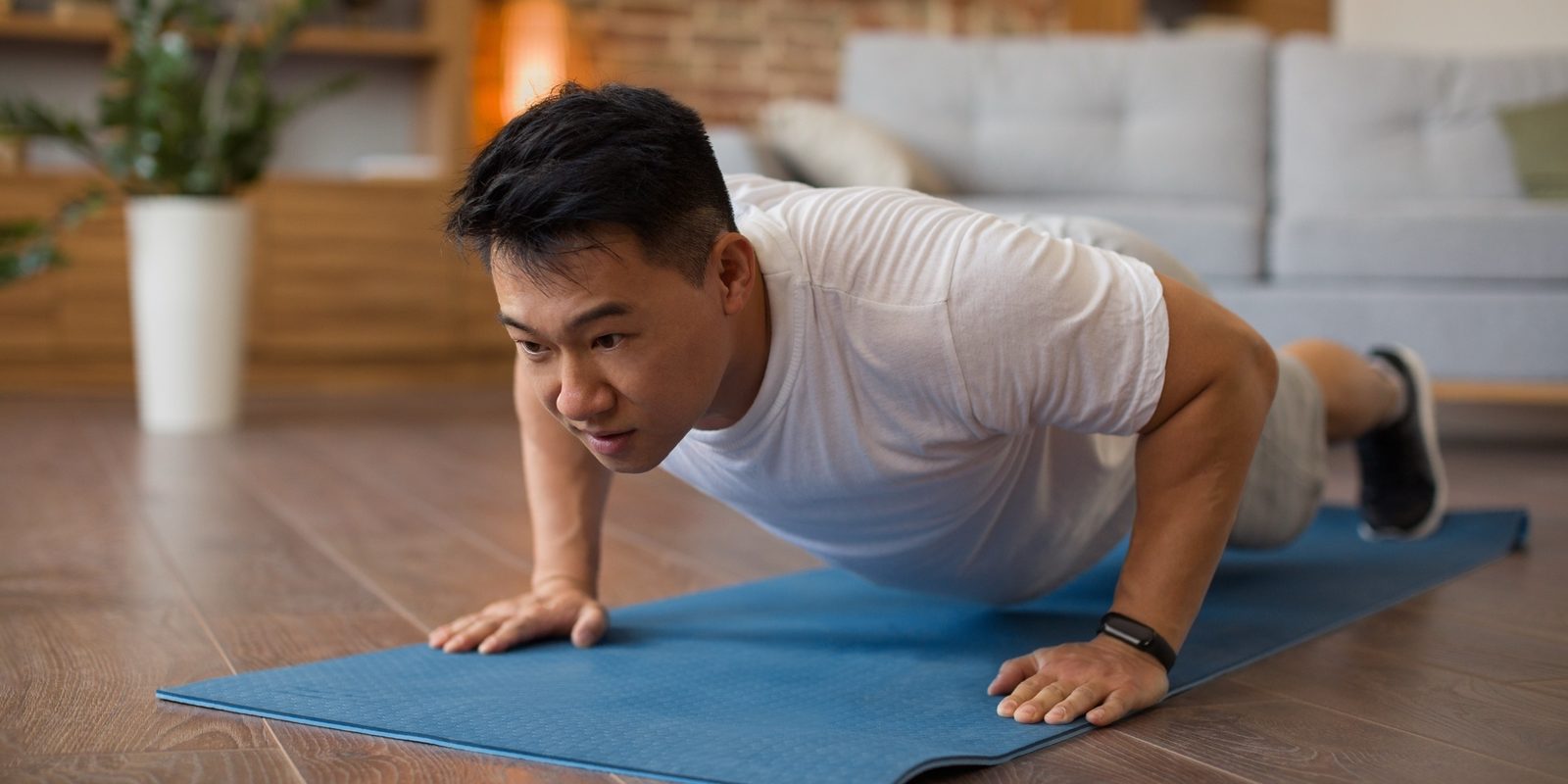
A few simple tests give you a starting point and show progress that the mirror and scale can miss. Pick three or four, do them the same way every time, and retest every 6 to 8 weeks.
Why it matters: A coach would test you before writing a plan. These tests let you do the same at home or in the gym, with no special equipment.
Before you test
- Check your health first. Use the safety self-check, and talk to your doctor if it says to.
- Warm up for 5 to 10 minutes before every test.
- Test when rested, not the day after a hard workout.
- Write it all down: date, time of day, results and anything unusual (poor sleep, a cold).
- Compare with yourself, not with charts. Your own improvement is the number that matters.
Cardio fitness: pick one
Rockport 1-mile walk (good for beginners and older adults)
- Walk 1 mile on a flat track or treadmill as fast as you can without jogging.
- Note your time in minutes (convert seconds: 30 seconds = 0.5 minute).
- Take your heart rate right at the finish, in beats per minute.
- Estimate your VO2 max (mL/kg/min):
132.853 − (0.0769 × weight in lb) − (0.3877 × age) + (6.315 if male, 0 if female) − (3.2649 × time in minutes) − (0.1565 × heart rate)
Example: a 50-year-old woman weighing 160 lb who walks the mile in 15.5 minutes with a heart rate of 140 scores about 132.853 − 12.30 − 19.39 − 50.61 − 21.91 = 28.6.
Cooper 12-minute run (for people who already run)
- Run or run-walk as far as you can in 12 minutes on a measured track.
- Record the distance in miles.
- Estimate your VO2 max (the most oxygen your body can use, a common measure of cardio fitness): (miles × 1,609 − 504.9) ÷ 44.73.
Example: 1.5 miles = 2,414 meters, so (2,414 − 504.9) ÷ 44.73 = 42.7.
Both are estimates. Use them to track change over time.
Strength and muscular endurance
Push-ups
- Do as many as you can with good form: body straight, chest to a fist's height from the floor, arms fully straight at the top.
- Use your knees or an incline (hands on a bench) if needed, and test the same way each time.
- Stop when your form breaks.
Pull-ups or inverted rows
- Pull-ups: hang with straight arms, pull until your chin clears the bar. Count full reps.
- Can't do one yet? Do inverted rows under a bar or sturdy table, feet on the floor, body straight. Count reps to form failure.
Wall sit
- Back flat on a wall, thighs parallel to the floor. Time how long you can hold it.
Power
Vertical jump (wall reach)
- Stand side-on to a wall and reach as high as you can. Mark the spot (chalk on your fingertips helps).
- From a standing start, jump and touch the wall as high as you can.
- The difference in inches is your jump. Take the best of three.
Standing broad jump
- Stand with toes behind a line.
- Swing your arms and jump forward as far as you can, landing on both feet.
- Measure from the line to the back of your nearest heel. Best of three.
Mobility
Knee-to-wall ankle test
- Kneel half-way, front foot facing a wall.
- Push your knee forward to touch the wall without lifting your heel.
- Move the foot back until you can just touch. Measure from big toe to wall.
- Test both sides. Many people reach about 4 inches or more; a big difference between sides is worth working on.
Core endurance
Time each hold until form breaks. Rest a few minutes between tests.
- Side plank (each side): on your elbow and feet, body straight. Compare the two sides; they should be close.
- Back extensor hold: lie face down on a bench with your upper body off the end, partner holding your legs. Hold your body level.
- Trunk flexor hold: sit with knees bent, back leaning at about 60 degrees against a support. Remove the support and hold.
Track each one against yourself. A back extensor hold shorter than your flexor hold is common and worth training.
Your test sheet
| Test | Date | Result | Notes |
|---|---|---|---|
| Rockport or Cooper | |||
| Push-ups | |||
| Pull-ups or rows | |||
| Vertical jump | |||
| Broad jump | |||
| Knee-to-wall (L / R) | |||
| Side plank (L / R) |
Related guides
- Tracking your progress
- Setting goals that stick
Related articles
- Measuring your progress
- How accurate is your body-fat number?
- The cardio dose