 Science To Fit
The science › Exercise › Programs and planning
Program guide: strength
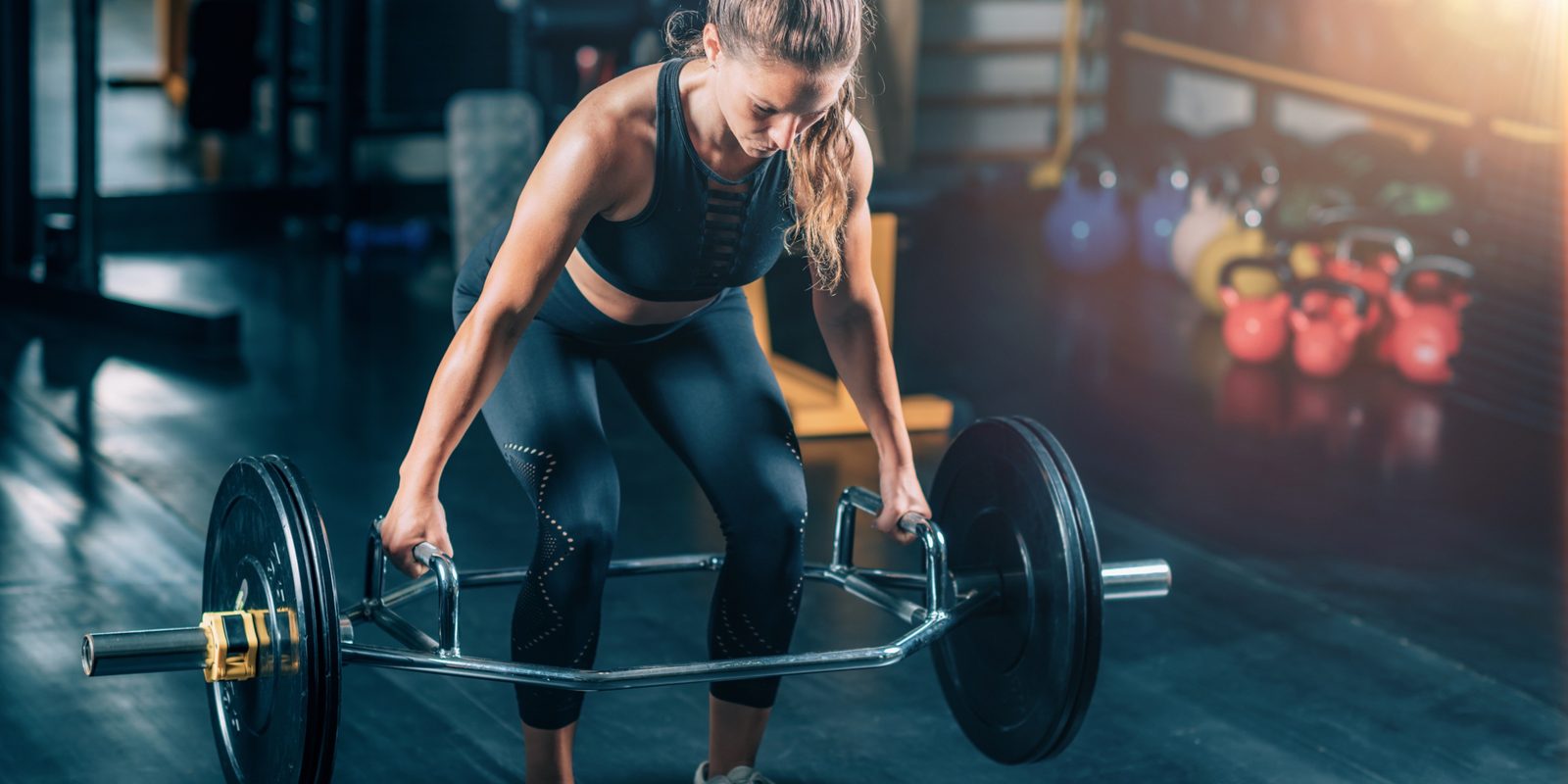
Heavy sets of 3 to 6 reps on the main lifts, practiced two to four times a week with long rests. It builds the most strength for the time you spend, and some muscle along the way.
Why it matters: Strength is specific. You get strongest at the lifts you practice, with heavy weights, done often. This program is built around those three facts.
The program at a glance
| Setting | Strength program |
|---|---|
| Strength days | 2 or 3 full-body days, or 4 days split upper and lower body |
| Session length | About 45 to 70 minutes |
| Main lifts | 4 sets of 3 to 6 reps |
| Extra exercises | 2 sets of 8 to 12 reps (core 10 to 15) |
| Effort | Stop each set with 1 to 3 reps left in the tank |
| Rest | 2½ minutes on main lifts, 1½ minutes on extras |
| Weekly target | At least 4 hard sets for each big muscle group; most get 8 or more |
| Cardio | About 150 minutes a week |
| Total time | About 5 to 6½ hours a week |
The workouts
Machines (start here): heavy sets on machines: leg press, hack squat, chest press, shoulder press, rows and pull-downs. No balance or spotter needed.
Free weights: the classic barbell lifts: back squat, bench press, deadlift, Romanian deadlift and overhead press, plus pull-ups and rows.
Machines and free weights: barbell squat, bench press and deadlift as the main lifts, machines for the rest.
Choose your days:
- 2 days: Day A and Day B, full body.
- 3 days (the default): Day A, B and C, full body.
- 4 days: two lower-body days and two upper-body days.
The main lifts: a squat, a hip hinge (pushing your hips straight back, as if closing a drawer behind you), a horizontal press, an overhead press, a row and a pull-down or pull-up. Extras such as lunges, curls, triceps exercises, calves and core get lighter sets.
A sample 3-day week (free weights):
| Day | Session |
|---|---|
| Monday | Back squat, bench press, dumbbell row, curls, core |
| Tuesday | Walk or cardio, 50 minutes |
| Wednesday | Deadlift, overhead press, pull-ups, reverse lunges |
| Thursday | Walk or cardio, 50 minutes |
| Friday | Goblet squat, incline dumbbell press, barbell row, triceps, calves |
| Saturday | Walk or cardio, 50 minutes |
| Sunday | Rest |
Why these exercises
- Practice the lifts you want to get strong at. Strength gains are closely tied to how you train. In a 2023 meta-analysis, free-weight training raised free-weight strength more than machine training did, while muscle growth was similar with either [1].
- That's why there are three versions. Pick the equipment you want to be strong on. Machines are the easiest start; free weights build strength on the barbell lifts.
- Big, multi-joint lifts first. Compound lifts train the most muscle for the time. Adding single-joint exercises didn't add measurable whole-muscle growth on average in a 2023 meta-analysis [2]. The program keeps a few for balance and joint health, with fewer sets.
- A straight-bar deadlift for the hip hinge. Keeping the bar close, dragging up the front of your legs, trains the hamstrings, glutes and lower back together. In a 2016 study of 20 trained men, the straight bar worked the hamstrings and lower back harder than a hexagonal bar did [9].
- The dumbbell deadlift is the easier start. It's the same movement with lighter, more manageable weights held at your sides. Learn it there, then move to the barbell once it feels solid.
Why these sets and reps
- 3 to 6 reps on the main lifts. In a 2021 network meta-analysis of 28 studies, heavy loads (8 reps or fewer) built more strength than light ones, while muscle growth was similar across loads [3].
- 4 sets each. A 2026 analysis of 67 studies found more weekly sets built more strength, but the returns shrank faster for strength than for size [4]. Four sets of a main lift, two or three times a week, gives plenty of practice without very long sessions.
- Stop 1 to 3 reps short of failure. A 2024 set of analyses found strength gains looked similar across a wide range of effort, while muscle growth improved closer to failure [5]. For strength, there's little to gain from grinding out the last rep.
- Failure costs recovery. In a 2017 study of 10 trained men, sets taken to failure on bench press and squat took 24 to 48 hours longer to recover from [6].
- 8 to 12 reps on the extras. They're there for muscle and balance, not maximum strength, so moderate weights do the job with less wear.
Why this rest
- 2½ minutes on main lifts. In a 2016 trial of 21 trained men, 3-minute rests raised squat strength 15.2%, compared with 7.6% with 1-minute rests [7].
- Heavy sets need it. The fuel your muscles use for short, hard efforts (phosphocreatine) takes several minutes to fully restock [8]. Short rests mean fewer good reps on the next set.
Why this many days
- More practice, more strength. In the 2026 analysis, training a muscle more often helped strength, with each added day helping less [4]. Most main lifts appear two or three times a week in every version.
- The split is about your schedule. With 4 days, upper and lower body alternate, so each session is shorter and each lift still gets practiced twice.
How it progresses
- Learn each lift light. Spend the first week or two with weights you could lift several more times.
- Add a rep each workout. Today's workout adds one rep to one set each time.
- Then add weight. When every set reaches 6 reps (12 on extras), the weight goes up 5 lb for upper-body lifts or 10 lb for lower-body ones, and the reps start over at the bottom of the range.
- Miss a target? Repeat the same targets next time.
Safety: use a rack with safety arms, or a spotter (a partner ready to help with the bar), on heavy squats and bench presses. Breathing: breathe in as you lower the weight, tighten your stomach muscles, then breathe out steadily as you lift (see "Breathing during lifts").
Reality check: Most studies lasted weeks to a few months and tested young adults, most of them men. The rest-period evidence rests largely on one small trial.
How sure are we: Strong that heavier loads build more strength. Moderate that training a lift more often helps strength. Moderate that longer rests help strength, since that rests on few trials.
Related guides
Related articles
- The strength training dose
- How to keep getting stronger
- Training to failure
- How long to rest between sets
Sources
- Haugen ME, Vårvik FT, Larsen S, Haugen AS, van den Tillaar R, Bjørnsen T. Effect of free-weight vs. machine-based strength training on maximal strength, hypertrophy and jump performance: a systematic review and meta-analysis. BMC Sports Science, Medicine and Rehabilitation. 2023;15(1). doi:10.1186/s13102-023-00713-4
- Rosa A, Vazquez G, Grgic J, Balachandran AT, Orazem J, Schoenfeld BJ. Hypertrophic effects of single- versus multi-joint exercise of the limb muscles: a systematic review and meta-analysis. Strength and Conditioning Journal. 2023;45(1):49–57. doi:10.1519/SSC.0000000000000720
- Lopez P, et al. Resistance training load effects on muscle hypertrophy and strength gain: systematic review and network meta-analysis. Medicine & Science in Sports & Exercise. 2021;53(6):1206–1216. doi:10.1249/MSS.0000000000002585
- Pelland JC, Remmert JF, Robinson ZP, Hinson SR, et al. The resistance training dose response: meta-regressions exploring the effects of weekly volume and frequency on muscle hypertrophy and strength gains. Sports Medicine. 2026;56(2):481–505. doi:10.1007/s40279-025-02344-w
- Robinson ZP, Pelland JC, Remmert JF, Refalo MC, et al. Exploring the dose–response relationship between estimated resistance training proximity to failure, strength gain, and muscle hypertrophy: a series of meta-regressions. Sports Medicine. 2024;54(9):2209–2231. doi:10.1007/s40279-024-02069-2
- Morán-Navarro R, Pérez CE, Mora-Rodríguez R, et al. Time course of recovery following resistance training leading or not to failure. European Journal of Applied Physiology. 2017;117:2387–2399. doi:10.1007/s00421-017-3725-7
- Schoenfeld BJ, Pope ZK, Benik FM, et al. Longer interset rest periods enhance muscle strength and hypertrophy in resistance-trained men. Journal of Strength and Conditioning Research. 2016;30(7):1805–1812.
- McMahon S, Jenkins D. Factors affecting the rate of phosphocreatine resynthesis following intense exercise. Sports Medicine. 2002;32(12):761–784.
- Camara KD, Coburn JW, Dunnick DD, Brown LE, Galpin AJ, Costa PB. An examination of muscle activation and power characteristics while performing the deadlift exercise with straight and hexagonal barbells. Journal of Strength and Conditioning Research. 2016;30(5):1183–1188.