 Science To Fit
The science › Exercise › Strength and muscle
How to keep getting stronger
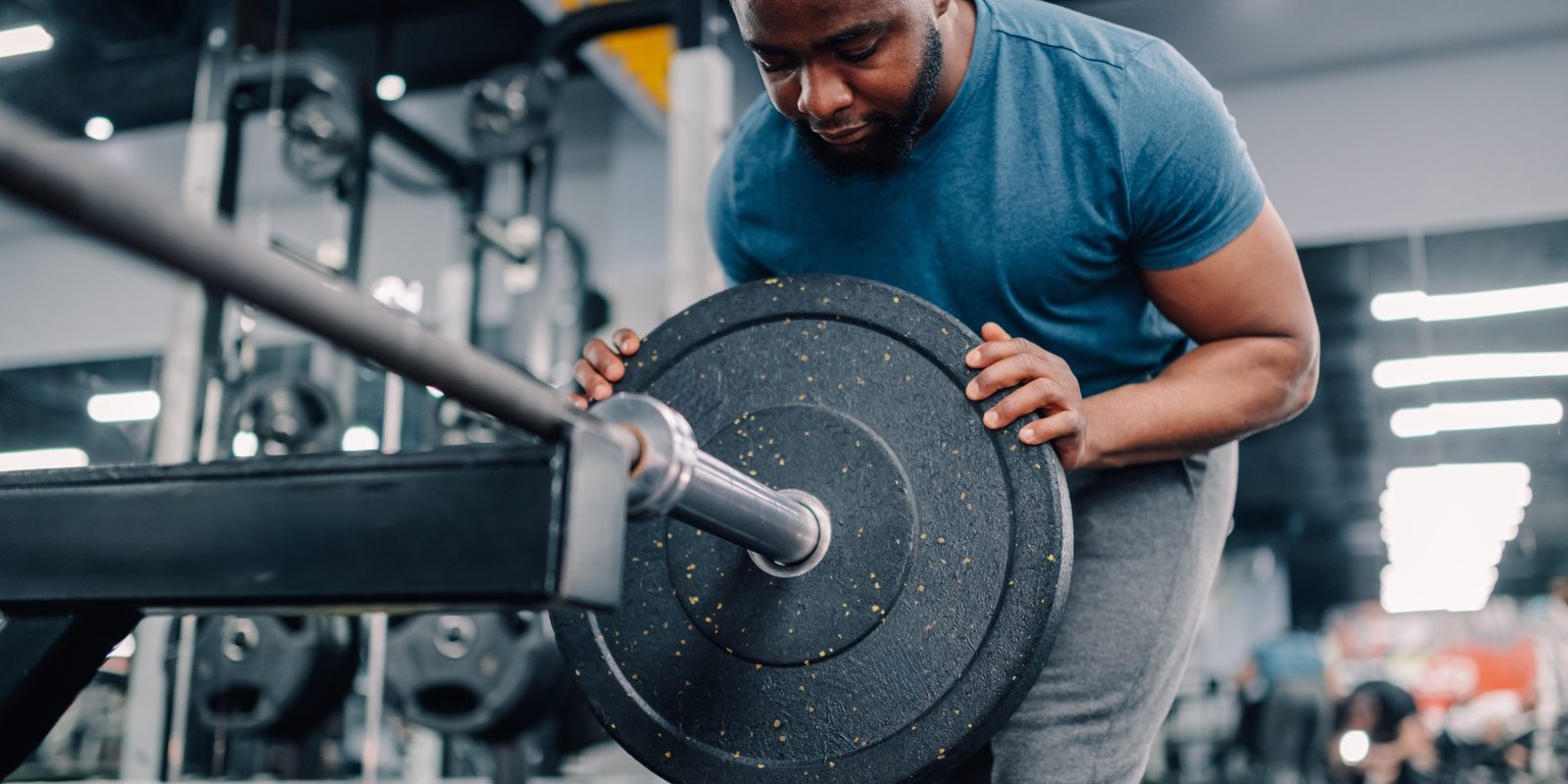
To keep getting stronger, add reps at the same weight until you top your rep range, then add weight and start again.
Why it matters: Without a clear rule for moving forward, it is easy to lift the same weights for months, or to add weight so fast that form breaks down. A simple system avoids both.
The big picture: Research found adding reps worked about as well as adding weight.
The method
The terms:
- Rep (repetition): one complete lift and lower.
- Set: a group of reps done back to back, followed by a rest.
- Rep range: the target number of reps per set, such as 8 to 10. Your program sets it.
- Weight (load): how heavy the weight is.
- Reps in reserve: how many more reps you could have done when you stopped. A hard set ends with about 0 to 3 in reserve.
How it works: This method is often called double progression, because you progress two things in turn: first reps, then weight.
- Start light enough to do the bottom of the range, such as 8 reps, with 2 or 3 reps to spare.
- Add reps at the same weight, session by session. One more rep on one set counts as progress.
- Reach the top. When every set reaches the top of the range, such as 10 reps, with good form, the weight has become too light for the range.
- Add weight by the smallest step available. That's often 2.5 to 5 lb for upper-body lifts and 5 to 10 lb for lower-body lifts.
- Drop back to the bottom of the range with the new weight. The reps go down because the weight went up.
- Repeat. Climb back to the top of the range, then add weight again.
An example: a machine chest press, 3 sets of 8 to 10 reps. Each session, add one rep to one set, the set with the fewest reps.
| Session | Weight | Set 1 | Set 2 | Set 3 | Next session |
|---|---|---|---|---|---|
| 1 | 50 lb | 8 | 8 | 8 | Add a rep to set 1 |
| 2 | 50 lb | 9 | 8 | 8 | Add a rep to set 2 |
| 3 | 50 lb | 9 | 9 | 8 | Add a rep to set 3 |
| 4 | 50 lb | 9 | 9 | 9 | Add a rep to set 1 |
| 5 | 50 lb | 10 | 9 | 9 | Add a rep to set 2 |
| 6 | 50 lb | 10 | 10 | 9 | Add a rep to set 3 |
| 7 | 50 lb | 10 | 10 | 10 | Every set at the top: add 5 lb |
| 8 | 55 lb | 8 | 8 | 8 | Back at the bottom: start climbing again |
Let the planner keep track: Today's workout in Plan my workouts does this for you. Log each set and it fills in your next targets, adds weight when every set reaches the top, and flags a stall if your reps stop rising for 3 weeks.
A wider range, such as 8 to 12, works the same way; it just takes more sessions to reach the top.
Some sessions you'll beat the plan by more than one rep; that's fine too. Enter a starting weight in the workout planner and its printed log sheets fill in these targets for you.
Between the lines: Progress won't come every session, and that's normal. Some sessions you'll match last time. The log shows the trend over weeks, which is what counts.
Go deeper
Why a range works:
- A 2021 meta-analysis found that heavy (8 or fewer reps), moderate (9 to 15) and light (more than 15) loads built similar muscle when sets were taken to failure. Heavier loads built more strength [1].
- So the exact number matters less than working hard within the range. The range gives you room to improve at the same weight before you add more.
Adding reps or adding weight:
- A 2022 trial assigned 43 trained adults to progress for 8 weeks either by adding weight at the same reps or by adding reps at the same weight [2].
- Muscle growth was similar, with a small, uncertain edge in one thigh muscle for the reps group.
- The weight group gained about 4.4 lb (2.0 kg) more on its squat maximum, a difference the authors called of questionable practical importance.
Judging effort:
- A widely used scale rates effort by reps in reserve: 10 means no reps left, 9 means one left, and so on [3].
- People aren't perfect at this. A 2022 analysis of 12 studies found people underestimated how many reps they had left by about 1 on average. Estimates were more accurate close to failure and on sets of 12 reps or fewer, and training experience made little difference [4].
More sets, smaller returns: A 2026 analysis of 67 studies found that more weekly sets meant more muscle and strength, with each added set bringing a smaller gain [5]. Adding a set is another way to progress when reps and weight stall.
Reality check: The reps-versus-weight trial lasted 8 weeks, tested trained adults, and covered leg exercises only.
How sure are we: Strong that hard sets across a wide range of reps build muscle. Moderate that adding reps works as well as adding weight, since that rests on one trial.
Keep it working
- Write everything down: weight, reps for each set, and rest time. A log is the only reliable way to know you're progressing.
- Keep form and rest the same. Extra reps only count if they're done the same way as before.
- Use the smallest weight jump available. Big jumps often push you below the bottom of the range.
- If you stall for a few weeks, add a set before changing the program. See "When progress stalls."
Sources
- Lopez P, et al. Resistance training load effects on muscle hypertrophy and strength gain: systematic review and network meta-analysis. Medicine & Science in Sports & Exercise. 2021;53(6):1206–1216. doi:10.1249/MSS.0000000000002585
- Plotkin D, et al. Progressive overload without progressing load? The effects of load or repetition progression on muscular adaptations. PeerJ. 2022;10:e14142. doi:10.7717/peerj.14142
- Zourdos MC, Klemp A, Dolan C, et al. Novel resistance training-specific rating of perceived exertion scale measuring repetitions in reserve. Journal of Strength and Conditioning Research. 2016;30(1):267–275. doi:10.1519/JSC.0000000000001049
- Halperin I, Malleron T, Har-Nir I, et al. Accuracy in predicting repetitions to task failure in resistance exercise: a scoping review and exploratory meta-analysis. Sports Medicine. 2022;52:377–390. doi:10.1007/s40279-021-01559-x
- Pelland JC, Remmert JF, Robinson ZP, Hinson SR, et al. The resistance training dose response: meta-regressions exploring the effects of weekly volume and frequency on muscle hypertrophy and strength gains. Sports Medicine. 2026;56(2):481–505. doi:10.1007/s40279-025-02344-w