 Science To Fit
The science › Exercise › Strength and muscle
Strength as you age
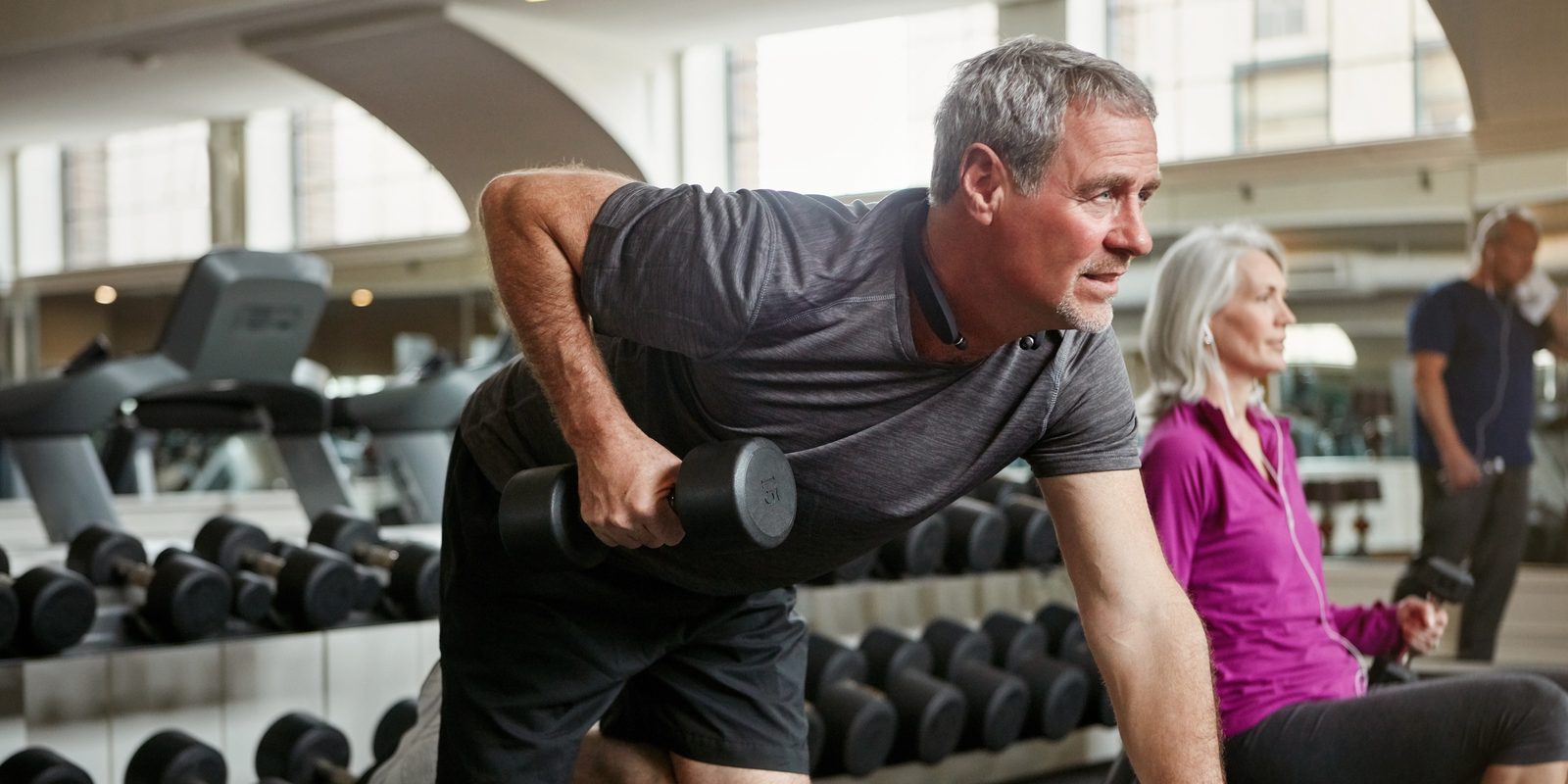
Strength training works at any age: 90-year-olds nearly tripled their strength in eight weeks.
Why it matters: Strength, more than muscle size, predicts whether older adults stay independent. It's the difference between getting up from the floor, carrying groceries and climbing stairs, or not.
The big picture: After about 70, adults lose roughly 0.5% to 1% of their muscle a year and strength two to five times faster. In 121 trials, older adults who trained gained strength and got up from chairs more easily.
What to do with this
- Lift two or more days a week, working all major muscle groups (see "The strength training dose").
- Work hard enough: sets that feel challenging by the last few reps. Light, easy weights do less.
- Include leg exercises like sit-to-stands, step-ups and leg presses, which carry over to daily life.
- Add balance training, which cuts falls (see "Balance training: what it really does").
- Eat enough protein, at least 0.45 to 0.55 grams per pound (1.0 to 1.2 g/kg) a day for adults over 65 [1].
- Start supervised if you're new, have a health condition or have fallen (see "Exercise with a health condition").
Go deeper
The terms:
- Sarcopenia: age-related loss of muscle mass and function, enough to affect daily life.
- Dynapenia: age-related loss of strength.
- Progressive resistance training: strength training where the load increases as you get stronger.
- Physical function: the ability to do everyday tasks, such as walking, climbing stairs and rising from a chair.
What people believe: It's too late to build muscle in old age, lifting is dangerous for older people, or walking is enough.
By the numbers:
- After age 70, muscle mass falls by about 0.5 to 1% a year. In a five-year study of 1,678 older adults, men lost about 16% of their thigh strength but only about 5% of their thigh muscle; women lost 13% of their strength and 3% of their muscle [2].
- Strength loss is a more consistent predictor of disability and death than muscle loss [2].
Training works:
- In a 1990 study, frail nursing-home residents with an average age of 90 trained their legs at high intensity for eight weeks. In the nine who finished, strength rose 174% on average, thigh muscle grew 9%, and walking speed improved [3].
- A Cochrane review of 121 trials with 6,700 older adults found strength training produced large strength gains, a moderate-to-large improvement in rising from a chair, a small gain in walking speed and a small improvement in physical function [4].
- Serious side effects were rare; joint pain and soreness were the most common complaints [4].
Falls and health:
- Exercise programs cut the rate of falls in older adults by 23%. Programs combining balance and strength probably cut them by about a third [5].
- Muscle-strengthening activity was linked to a 10 to 17% lower risk of early death and major diseases [6].
Between the lines: The losses come from both aging and inactivity, and only one is up to you. Older muscles respond to training; it just takes consistency.
Reality check: Many trials were small and short, and side effects were poorly recorded. The 1990 study had nine people. Results for physical function were smaller than for strength.
How sure are we: Strong that older adults gain strength from resistance training. Moderate that it improves everyday physical function. Strong that exercise reduces falls. Moderate on protein targets for older adults.
Getting started
- Pick 6 to 8 exercises: sit-to-stand or leg press, step-ups, a row, a chest press, an overhead press, a hip hinge, and a carry.
- Start with 1 to 2 sets of 8 to 12 reps at a weight you could lift a couple more times.
- Add weight or reps when it gets easy (see "How to keep getting stronger").
- Train two or three days a week, with a rest day between.
- Add balance work at the start or end of each session.
Sources
- Bauer J, Biolo G, Cederholm T, et al. Evidence-based recommendations for optimal dietary protein intake in older people: a position paper from the PROT-AGE Study Group. Journal of the American Medical Directors Association. 2013;14(8):542–559. doi:10.1016/j.jamda.2013.05.021 (Context: expert position paper.)
- Mitchell WK, Williams J, Atherton P, Larvin M, Lund J, Narici M. Sarcopenia, dynapenia, and the impact of advancing age on human skeletal muscle size and strength; a quantitative review. Frontiers in Physiology. 2012;3:260. doi:10.3389/fphys.2012.00260
- Fiatarone MA, Marks EC, Ryan ND, Meredith CN, Lipsitz LA, Evans WJ. High-intensity strength training in nonagenarians: effects on skeletal muscle. JAMA. 1990;263(22):3029–3034.
- Liu CJ, Latham NK. Progressive resistance strength training for improving physical function in older adults. Cochrane Database of Systematic Reviews. 2009;(3):CD002759. doi:10.1002/14651858.CD002759.pub2
- Sherrington C, Fairhall NJ, Wallbank GK, et al. Exercise for preventing falls in older people living in the community. Cochrane Database of Systematic Reviews. 2019;(1):CD012424. doi:10.1002/14651858.CD012424.pub2
- Momma H, et al. Muscle-strengthening activities are associated with lower risk and mortality in major non-communicable diseases: a systematic review and meta-analysis of cohort studies. British Journal of Sports Medicine. 2022;56(13):755–763.